History
ROCK AND OCHRE c. 41,200–39,500 cal BP 15+

ROCK AND OCHRE

A Palaeolithic Trilogy of the Last Southern Refugium

c. 41,200–39,500 cal BP · 15+

Continuous 3-volume Spine S-1 mural (0.324 / 0.3333 / 0.3427 slice ratios across 360 / 370 / 380 pp: 0.81 / 0.83 / 0.86 in [20.6 / 21.2 / 21.7 mm] on KDP 0.002252 in/page standard-colour wrap stock, or 0.900 / 0.925 / 0.950 in on 0.0025 in/page cream stock) spanning the emerged -80 m Gibraltar stone-pine savanna.

Archaeometric & Palaeoecological Framing

Set across a single extended human lifespan (c. 41,200–39,500 cal BP) between the 426 m Jurassic dolomite crest of Gibraltar and the upland karst of Cueva de Ardales, ROCK AND OCHRE reconstructs southern Iberian Neanderthal life strictly from excavated stratigraphy, lipid biomarkers, and palaeobathymetry, without teleological doom or invented written scripts.

The Undrowned -80 m Coastal Savanna

Gorham’s and Vanguard Caves were not sea-washed cliff hollows during Marine Isotope Stage 3. Sea level stood roughly 80 metres below modern datum, exposing a 4.5 km eastern plain (35 km²) of Pinus pinea woodland, Cistus maquis, freshwater dune slacks, and intertidal mussel beds (Rodríguez-Vidal et al. 2013).

Anoxic 150–200 °C Rockrose Pitch

In Vanguard Cave, a 22 × 9 cm hearth pit with twin radial channels preserved labdane diterpenoid biomarkers from gum rockrose (Cistus ladanifer) heated beneath an oxygen-excluding seal of cave guano (bird and bat droppings) and damp marine sand to sweat ~100 ml of thermoplastic hafting adhesive from 1.9 kg of young leaves (Ochando et al. 2024; debated in Schmidt 2024).

13 Flint Grooves & Blown Red Haematite

Two physical marking traditions anchor the trilogy: the 13-stroke grid incised by 188–317 unidirectional flint passes into Gorham’s lime-mudstone platform (>39,000 cal BP, Rodríguez-Vidal et al. 2014) and mouth-blown exogenous red haematite veiled under U-Th dated calcite in Cueva de Ardales (>65.5 ka and 48.7–45.3 ka, Pitarch Martí et al. 2021).

Pre-Written-Records Discipline

Zero phonetic scripts, Neanderthal tally sticks, written calendars, shamans, or Homo sapiens rescue tropes appear in the prose. Dialogue relies on spare concrete English and embodied somatic craft, keeping modern scientific terminology inside this companion archive.

Interactive Palaeolithic Archaeometry Workbenches

Lab I · Gibraltar -80 m Savanna & Sand-Plug Explorer

Scrub Alboran sea level from 0 m modern cliff surf down to -85 m MIS 3 lowstand across the 4.5 km stone-pine plain, and toggle the ~40 ka Heinrich Stadial 4 carbonate sand ramp that sealed Vanguard’s upper 13 m chamber.

Lab II · Vanguard 150–200 °C Anoxic Tar-Hearth Simulator

Control sub-surface core temperature (40–380 °C) and cave-guano and marine-sand crust integrity across the 22 × 9 cm Vanguard pit (~2 h grass-and-shrub top burn) to test how oxygen exclusion yields ~100 ml of viscous Cistus ladanifer pitch (from 1.9 kg young leaves) while steelmanning the Schmidt 2024 taphonomic critique.

Lab III · Gorham’s 13-Stroke Grid & Ardales Ochre Studio

Sweep grazing pine-brand torchlight (10°–85°) across Gorham’s 8 deep and 5 thin lime-mudstone incisions, and inspect multi-generational mouth-blown #943424 haematite sealed under U-Th dated calcite in Cueva de Ardales.

Volumes

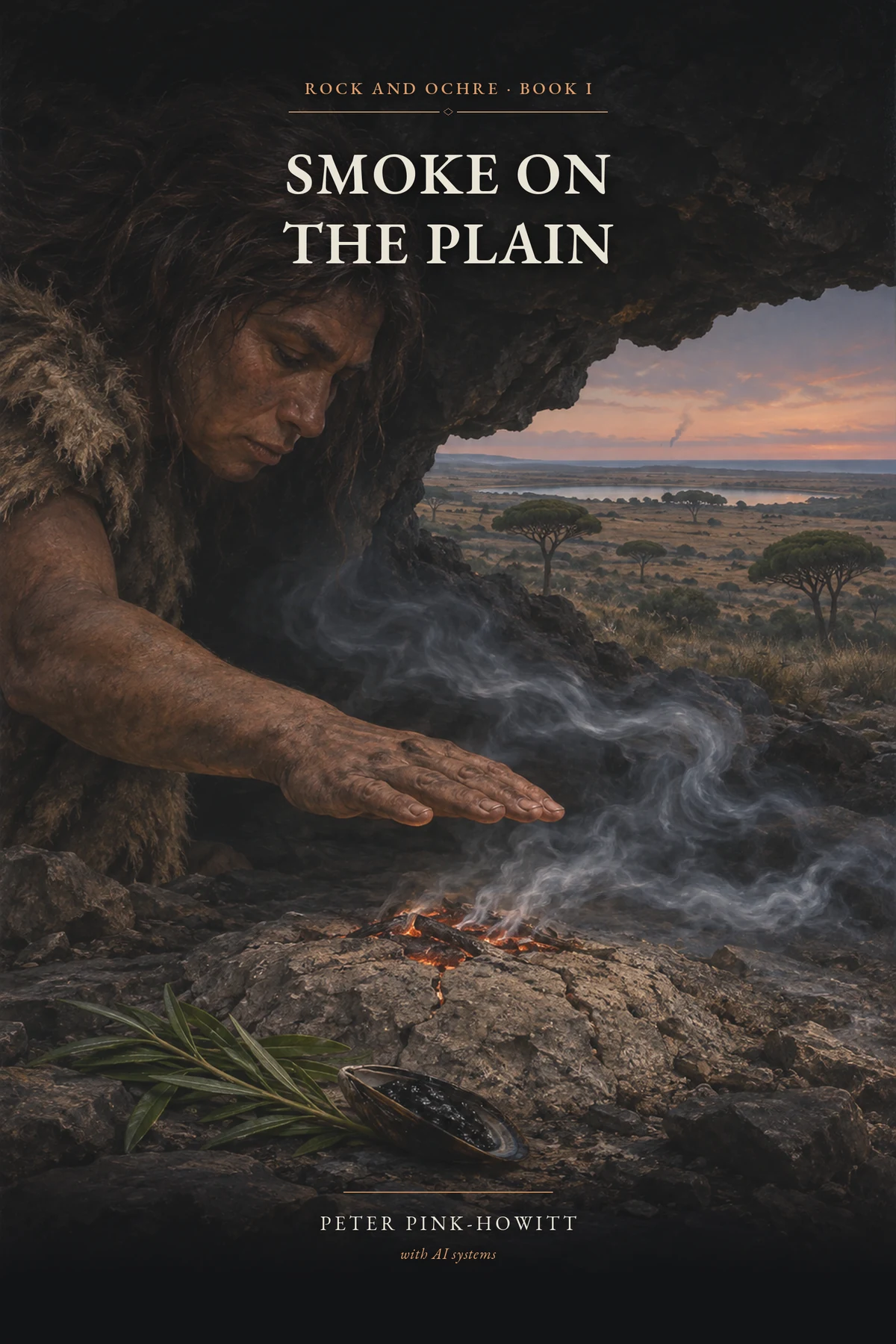
Cover for Book I: Smoke on the Plain

Book I: Smoke on the Plain 15+

c. 41,200–40,400 cal BP (Years 1–8). Above a 4.5-kilometre plain of stone pines, freshwater dune lagoons, and gum rockrose now drowned beneath the Alboran Sea, a fifteen-strong Mousterian band keeps the eastern cliff caves of the Rock. Resin-keeper Kesh distils glossy black Cistus ladanifer pitch beneath a cave-guano and marine-sand seal, walks a full-day 17 km trek northwest with master knapper Drom and apprentice Pelk for Guadarranque honey chert, and climbs the 280 m crags with cliff-fowler Sarn for griffon-vulture and dark raptor/corvid primaries, before a thin thread of stranger smoke rises over the eastern dunes where coastal shell-scout Olenai moves along the shore.

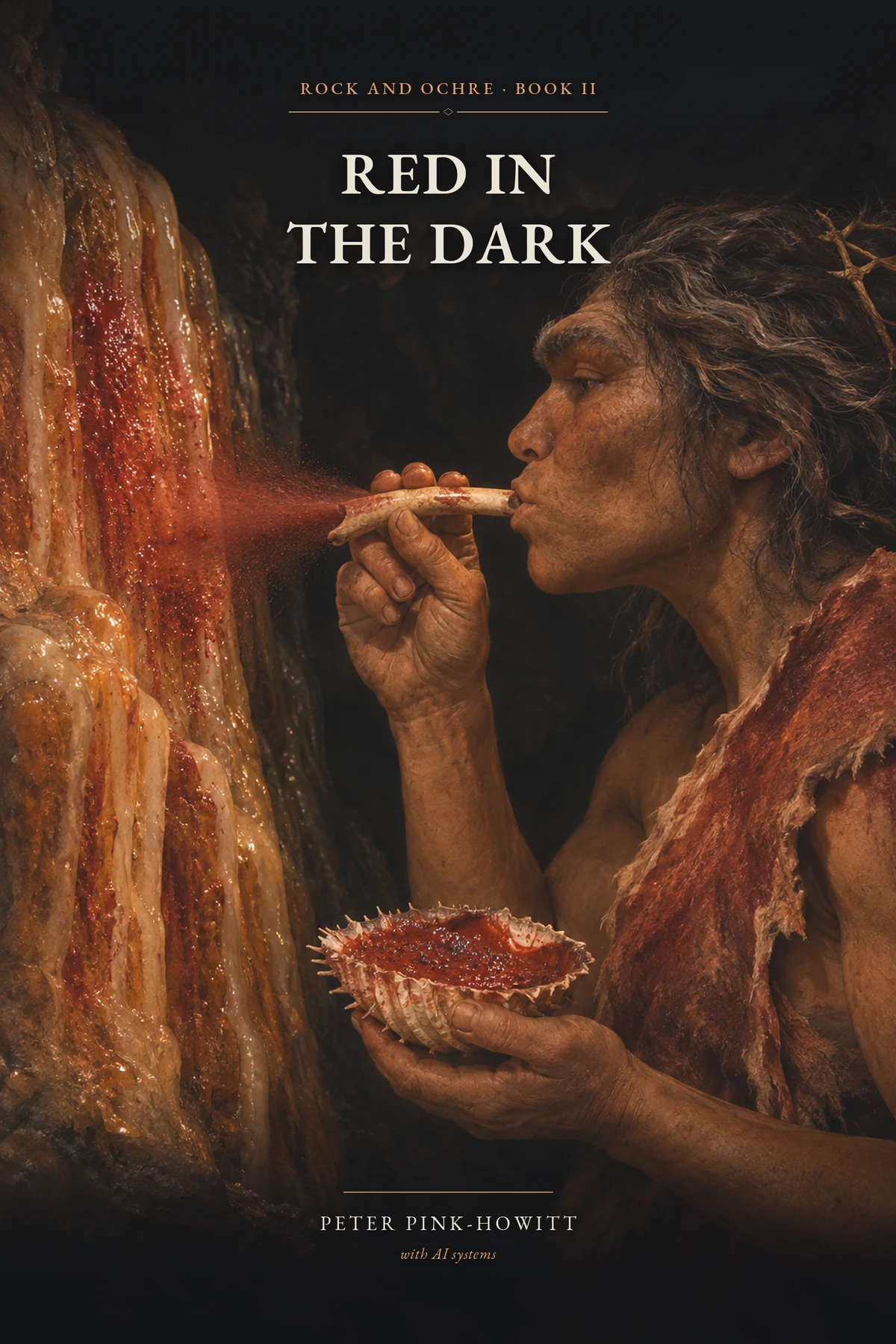
Cover for Book II: Red in the Dark

Book II: Red in the Dark 15+

c. 40,400–39,900 cal BP (Years 8–16). Holding a fragile coastal truce between Vanguard’s closed cave-hearth and the wide Tritia-shell exchange strands of Málaga Bay, Kesh and Sarn walk the six-sleep 115 km Guadiaro–Ronda–Turón limestone corridor toward the high cavern of Cueva de Ardales. Carrying exogenous red haematite in perforated Spondylus cups alongside griffon-vulture and dark raptor/corvid primaries into pitch-black karst galleries, they blow fresh #943424 pigment beside calcified ancestral stains while a seam-born child (Neth / Aruelai) grows between two incompatible vocal, sensory, and caloric worlds.

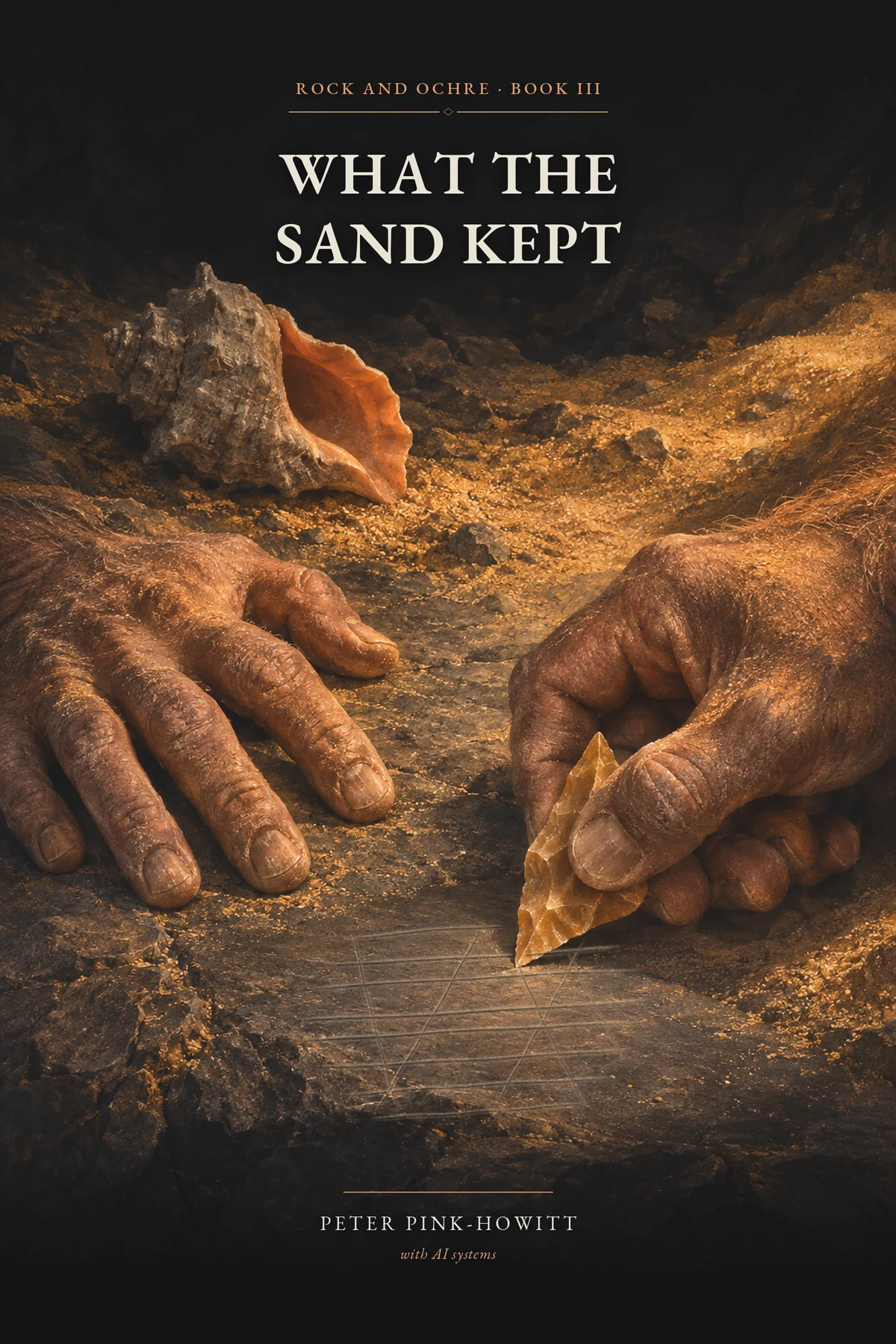
Cover for Book III: What the Sand Kept

Book III: What the Sand Kept 15+

c. 39,900–39,500 cal BP (Years 17–27). Cold-arid Heinrich Stadial 4 gales chill the Alboran Sea and drive climbing carbonate sand ramps 250 metres up the eastern cliff, choking the freshwater slacks and sealing Vanguard Cave’s upper 13-metre chamber over a placed marine whelk. As ageing resin-keeper Kesh tends the surviving Mousterian hearth, seam-born Neth / Aruelai and his younger sister face an asymmetric parting carried in bone and blood, while at the back of Gorham’s Cave a honey-chert burin cuts thirteen deliberate grooves (188–317 unidirectional passes) into the rear dolomite before wind-sand closes the stratum for forty thousand winters.

Chronology & Story Scrubber

c. 65,500+ BP (Ancestral Pier) — Earliest U-Th dated calcite crusts form over mouth-blown exogenous red haematite on the stalagmitic draperies of Cueva de Ardales, Málaga (Pitarch Martí et al. 2021). · Inherited deep-karst mineral veil already glowing beneath translucent cave stone generations before the trilogy opens.
c. 65,000 BP (Ancestral Pier) — Circular 22 × 9 cm anoxic distillation hearth with twin trenches sweats Cistus ladanifer hafting pitch beneath a cave-guano (bird and bat droppings) and marine-sand seal in Vanguard Cave (Ochando et al. 2024). · Craft lineage of the sealed rockrose tar pit maintained along the eastern Gibraltar shelf.
c. 41,200 cal BP · Year 1 — MIS 3 Alboran sea level stands ~80 m below present, exposing a 4.5 km coastal stone-pine savanna, dune lagoons, and Mytilus beds east of Gorham’s and Vanguard Caves (Rodríguez-Vidal et al. 2013). · Book I (Smoke on the Plain): Kesh seals her rockrose tar pit (~100 ml pitch from 1.9 kg young leaves) at Vanguard’s mouth, walks a full-day 17 km trek northwest for Guadarranque honey chert, and Sarn spots coastal camp-smoke on the eastern dunes.
c. 41,100–40,900 cal BP · Years 2–4 — Cut-marked corvid and dark raptor wing bones in Gorham’s, Vanguard, and Ibex Caves attest systematic removal of primary remiges rather than meat consumption (Finlayson et al. 2012). · Book I: Griffon-vulture and dark raptor/corvid primary harvesting on the 280 m crags, followed by a six-sleep 115 km inland drought trek up the Guadiaro–Ronda–Turón corridor.
c. 40,400–39,900 cal BP · Years 8–16 — Second U-Th dated pigment horizon at Cueva de Ardales (48.7–45.3 ka into late Mousterian) confirms repeated returns to blow non-local iron oxide across the Sala de las Estrellas curtains. · Book II (Red in the Dark): Kesh and Sarn walk the six-sleep 115 km Guadiaro–Ronda–Turón karst corridor to spit fresh #943424 exogenous haematite across Ardales’s dark-zone curtains.
c. 40,300–40,000 cal BP · Málaga Bay Shell-Strands — Early Upper Palaeolithic / Aurignacian occupation replaces late Mousterian Level Bj/14 in Level Bj/13 at Bajondillo Cave, Málaga Bay (43–41 cal ka BP, Cortés-Sánchez et al. 2019; debated in de la Peña 2019). · Book II: Coastal barter and fragile hearth-truce between Gibraltar’s Mousterian cave-kin and the Early Aurignacian Tritia-shell strands ascending from Málaga Bay as seam-born Neth / Aruelai grows between two worlds.
c. 39,600 cal BP · Gorham’s Rear Platform — Thirteen intersecting grooves (8 deep V-profiles + 5 thinner strokes; 188–317 unidirectional flint passes) are incised into a ~300 cm² dolomitic lime-mudstone platform sealed beneath Mousterian Level IV (>39,000 cal BP, Rodríguez-Vidal et al. 2014). · Book III (What the Sand Kept): Thirteen intersecting grooves cut by 188–317 unidirectional honey-chert passes into Gorham’s rear bedrock beside the pine-wood hearth.
c. 39,500 cal BP · Heinrich Stadial 4 — Cold-arid gale winds bank carbonate marine sands across Vanguard Cave’s upper 13 m chamber, sealing lynx, hyaena, griffon vulture, and a carried marine whelk shell untouched until September 2021 (Gibraltar Release 676/2021; Higham et al. 2014). · Book III: Heinrich Stadial 4 carbonate sand closes Vanguard’s upper 13 m arch as the seam-born siblings part between the Rock and the eastern coastal shell-network.