Archival Map
The Emerged Strait of Gibraltar & the Karst Corridor to Cueva de Ardales (c. 41,000 BP)
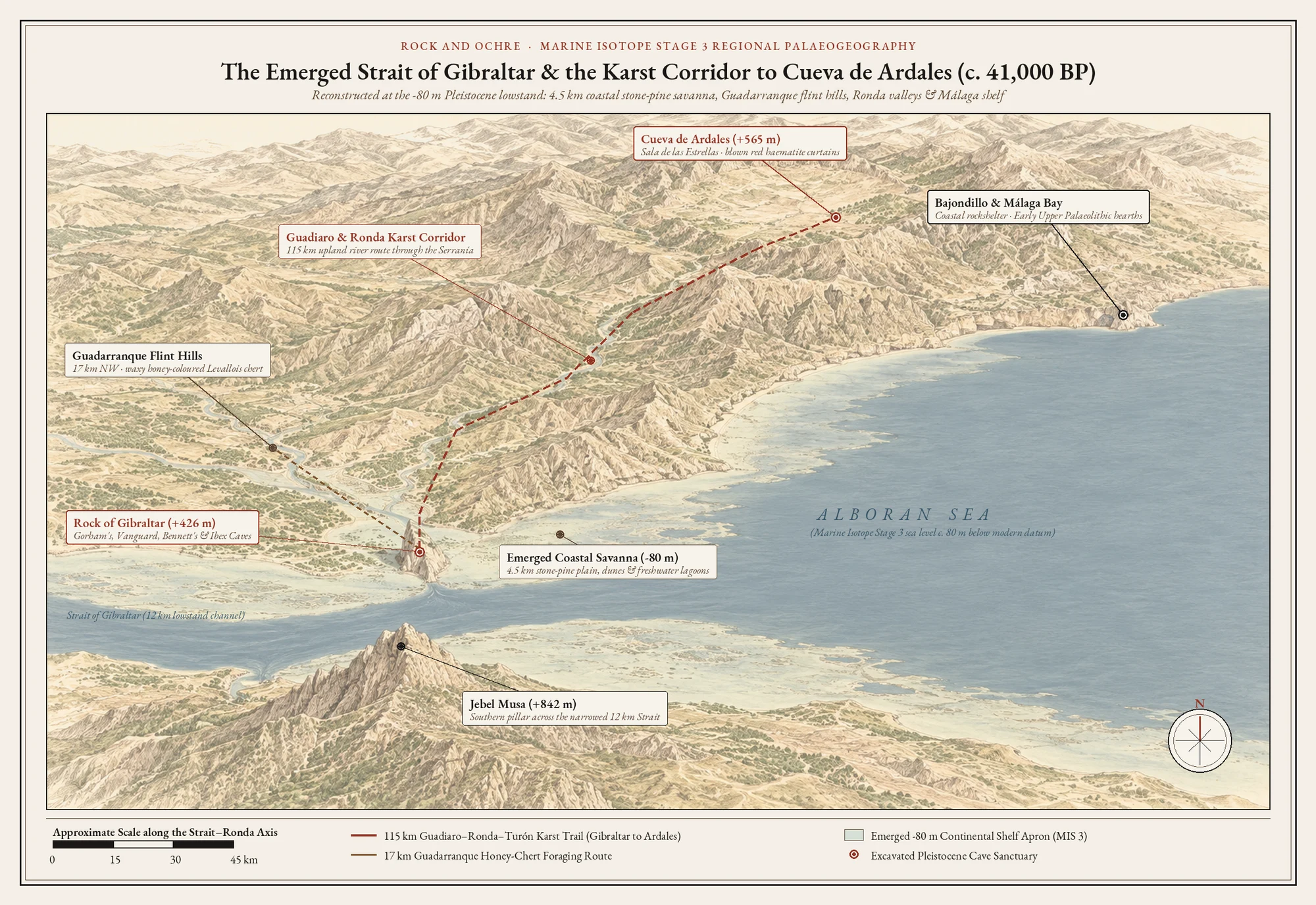
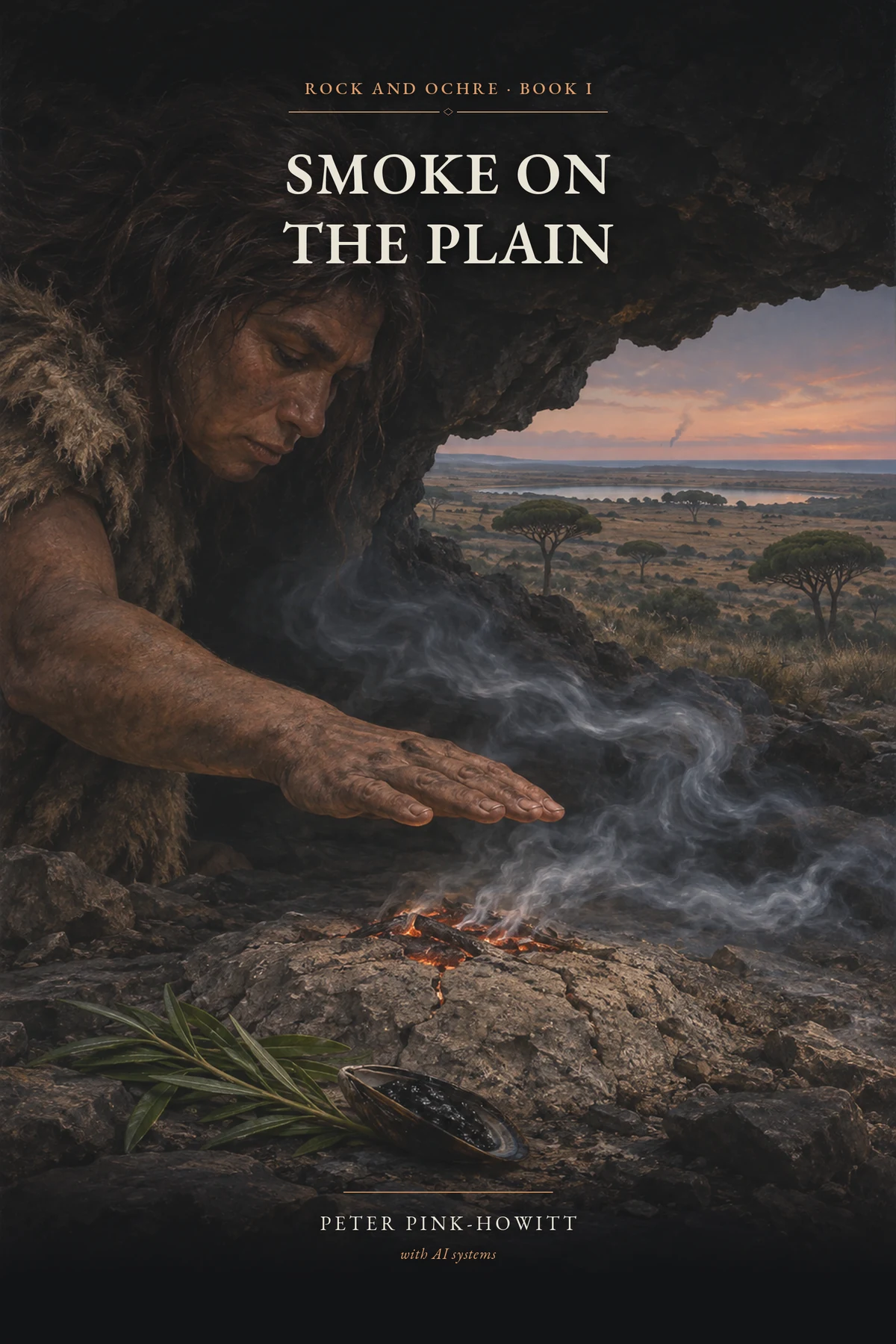
c. 41,200–40,400 cal BP (Years 1–8). Above a 4.5-kilometre plain of stone pines, freshwater dune lagoons, and gum rockrose now drowned beneath the Alboran Sea, a fifteen-strong Mousterian band keeps the eastern cliff caves of the Rock. Resin-keeper Kesh distils glossy black Cistus ladanifer pitch beneath a cave-guano and marine-sand seal, walks a full-day 17 km trek northwest with master knapper Drom and apprentice Pelk for Guadarranque honey chert, and climbs the 280 m crags with cliff-fowler Sarn for griffon-vulture and dark raptor/corvid primaries, before a thin thread of stranger smoke rises over the eastern dunes where coastal shell-scout Olenai moves along the shore.
The rockrose was sweating before the sun came up out of the sea.
Kesh felt it on the first leaf she stripped. The underside came away tacky against her thumb, and when she drew the thumb back a fine dark string of gum went with it and broke. Leaves that sweat at first light will sweat in the pit, if they go in wet and go in before the sun dries them.
She worked up the slope above the cave mouth with Pelk on her left and Bruk somewhere below her heels, stripping the long dark leaves into the hide sling at her hip, while the cloud-hat sat grey on the crest of the Rock and dripped onto the scree, and the east-wet wind laid the whole slope damp so that every bush smelled twice as strong as it would at the top of the sun-arc.
Pelk had a fistful of the old leaves, the pale curled ones from low on the stem. Kesh took them out of her hand and dropped them. She bent a young leaf from the tip of the same bush and laid Pelk’s fingers on the underside of it and pressed. Pelk’s fingers came away and stuck, and came away again.
“Same bush,” Pelk said.
“Same bush.”
Pelk looked at the leaves on the ground and then at the tip of the stem, and after that she stripped from the tips. She was thirteen winters and had hands quicker than Kesh’s own had been at thirteen, and she talked while she worked, which Kesh had stopped trying to cure.
“My mother says Red-Dome women don’t strip at all. She says they cut the whole bush and carry it.”
“Red-Dome women have a short carry. Their pit is at the foot of the slope.”
“Is it a good pit?”
“It was my mother’s pit.”
“Is that a yes?”
Kesh stripped a branch to the wood and moved to the next. Below them on the slope something thumped and swore, and Bruk came up through the bushes on his hands and knees with his lips stuck together. He had a lump of old tack in one cheek. He tried to speak and made a noise through his nose like a seal pup.
Pelk sat down in the rockrose and put her face into the crook of her arm.
Kesh caught her son by the back of the neck, worked her thumb into the corner of his mouth, and peeled. Bruk yelled. The tack came out with a thread of spit and a little skin from his lip.
“That’s mine,” Bruk said.
“It is the pit’s.” She put the lump in her sling. “Pick. From the tips.”
“My mouth tastes of it.”
“Then you will not be hungry.”
He was hungry anyway. They were all hungry. Three marrow-bones had hung in the dry niche over the whole-fire at last dark, the last of the hind Krel and Nesk had brought up from the plain at the fawn-drop, and three marrow-bones for fifteen mouths was a count Kesh could hold in one hand with two fingers left over for worry. The ibex-rut was two moons off. Between now and the rut there would be limpets, tortoise if the children were lucky in the scrub, rabbit if the snares held, and whatever the plain gave Krel’s spear.
The sling dragged at her hip once it was heavy, and the gum was already tacking the leaves to each other through the hide. She sent Pelk down with it before it could set into one mat, and filled her own arms, and went down after her to the cave mouth with the leaves held away from her body, because gum wiped off on a hide was gum lost from the pit.
The pit lay on the lee side of the fallen block at the mouth, out of the drip-line, where the sand stayed dry and the east-wet wind came round the block slow. She had dug it at the griffon-sitting and dug it again after every burn. It was the length of her forearm and the depth of her hand stood on its heel, with a side-trench at each end the width of two fingers and running down to a lower floor, and both trenches were black to the bottom with old gum.
Drom sat inside the mouth at the knapping place, where the light came in flat and grey off the sea, with his stiff knee straight out in front of him and a prepared core between his thighs.
He had the third marrow-bone in his teeth.
He was not hiding it. The split end of it stood out of his mouth and he worked it with his tongue while his hands worked the core, turning it, feeling for the next platform with the ball of his thumb. His hammerstone came down. A long flake sprang off the face and dropped onto the hide across his lap, clean, sharp all along one edge, the bulb fat and clean. He did not look at the flake. He turned the core again and sucked the bone.
Kesh laid her leaves down on the clean hide beside the pit. She did not look at Drom either. She knelt and began to pack.
Wet leaves went into the hollow tight, laid crosswise, pressed with the heel of the hand until the pit was full to its lip and then a thumb-height over it. Leaves on top of the trenches would block them, so the trench mouths stayed clear and the leaves banked up round them. She packed with both hands and both wrists, and Pelk fed her from the sling, and Bruk sat on the block and scraped tack from under his fingernails with his teeth.
Then the crust.
She had the sand ready in one hide and the bird-dung in another, scraped at dark from the ledge under the dove roost where it lay white and crusted and stinking. Two handfuls of sand to one of dung, wetted from the seal-skin bag, worked through her fingers until it held a thumb-print and did not run. She laid it over the packed leaves a thumb-breadth thick and pressed it down, and pressed the edges into the sand of the floor all round, and smoothed it with a wet palm until no leaf showed anywhere.
The crust would hold if it went on in one piece and dried from the top, before the fire was big. Kesh ran her palm round the whole edge again. Pelk watched her hand.
“You could put more dung on the far side,” Pelk said.
“Could I.”
“The wind comes round the block on that side.”
Kesh looked at the far side. The wind did come round the block on that side, slow, but it came. She scooped another two fingers of the wet dung and laid it along the far edge, and pressed it in, and said nothing, and Pelk sat back on her heels with a face she would carry for the rest of the morning.
She needed an edge for after.
Last burn’s gum had set hard on the lips of the limpet shells and on the cracking-stone, and the fresh gum would not take where the old gum sat. Her own flake from the rut was blunt from cutting hide. She stood up, brushed her knees, and walked into the cave to the knapping place.
Drom took the bone out of his mouth to look at her. There was marrow at the corner of his lip. She could smell it. It smelled the way marrow smells when the bone has been near the fire, sweet and fatty and a little burnt, and her belly turned over and made a sound.
“That,” Drom said, “was your belly.”
“It was.”
“Mine has stopped making that sound. You should eat more.”
“There was a bone hanging at dark.”
“There was. And now there is a bone in my hand. At dark I could not sleep for the knee, and the bone could not sleep for hanging there, and so we settled it between us.” He put it back in his mouth and spoke round it. “Bones are not counted till morning.”
“It is morning.”
“Then count it.” He held it out to her by the split end, empty, scraped white. “One.”
Behind her Bruk said something to Pelk, and Pelk hissed at him. Kesh did not turn round.
“I want a flake,” she said.
“You want a flake.” Drom looked down at the hide across his lap, where the new one lay with its clean edge catching the grey light. “I have flakes. My flakes go on shafts, and my shafts go into deer, and the deer goes into your son. That flake is for a point.”
“My gum goes on your shafts. Without it your points fall out in the first deer and stay there.”
“Three points by the rut.”
“Two.”
“Three. Krel breaks one a moon on aurochs he has no business walking at.”
She held her hand out flat. Drom set the core down, picked up the flake, turned it over once with a sorry face, and laid it across her palm. His fingers were cold and rough and very steady. Then he picked up the core again and turned it and felt the next platform with his thumb, and she was already turned away, and the hammerstone rang behind her on the stone with the high clean note that means the strike went in at the right angle and the flake is long.
The sinew line on Sarn’s shoulder smelled of the fat he had greased it with, and she smelled it before she turned. Krel came up from the back of the cave with his spear and Nesk behind him with two, and Sarn with them, his throwing-club through his belt. If they brought back nothing, the limpets would have to carry fifteen mouths until the rut. Sarn had the look on him he always had going out in the morning, of a man who is owed the day.
“Griffon on the high ledge,” Sarn said. “Dropped on the ibex kid at dark and couldn’t lift off. It’ll still be sitting there, full.”
“Then it will still be sitting there after you have eaten,” Kesh said.
“I have eaten.”
“What did you eat?”
He looked at Drom. Drom sucked the white end of the bone and looked at the sea.
Krel put his hand on the side of Kesh’s neck and left it there for a breath. His hand smelled of the spear-haft, which smelled of her gum. “Keep me a bone,” he said.
“There is no bone.”
“Keep me what there is.”
“I will keep you a limpet.”
“Two limpets. I am a big man.” He took his hand away and went out past the block and down onto the climbing dune, Nesk after him, and Sarn went the other way along the foot of the cliff toward the eastern crags with his sinew line bouncing, calling over his shoulder for Marn.
Kesh scraped the old gum off the lips of the shells with Drom’s flake, and off the cracking-stone, and dropped the black scrapings into the pit’s near trench, where they would melt again and not be lost. The edge was very good. She hated that it was very good.
She brought the ember up from the whole-fire in a mussel shell packed with ash and laid it on the crust with a nest of dry pine-needle, and blew. The needles took. She laid the kindling over, and when that caught she laid the first log, a length of dead pine as thick as her wrist and as long as her arm, square across the middle of the crust, and the second beside it, and sat back.
A two-log burn. When the second log fell in, the leaves under the crust would have given what they had.
The heat off the crust had come up into her knees by the time the sun cleared the sea-haze, and the drip off the crest had slowed, which meant the leaves would take no more wet from above so long as the cloud-hat stayed thin until the first log was down. She looked once down the plain. The pines, the dunes and the far white of the surf were where they always were, and none of it would burn or spoil before dusk.
The scraping at the mouth had a wet sound to it, which meant the deer hide was still too fresh to thin before it stiffened. Tesh White-Eye worked it with Reth and Hask on either side of her, the hide pegged out on the sand with bone pegs, her head tipped so the good eye was over the scraper; the other had gone white in the fawn-drop three winters back. If the fat came off clean before the sun reached it, there would be one more hide for the cold. Reth’s two and Hask’s boy were rolling in the drift-sand against the rear wall, and so long as they stayed there they were three mouths not under her feet.
“Out of the back sand,” Kesh called.
“We’re digging,” Tep called back.
“Dig at the front.”
“The front is hard.”
“The back stinks.”
It did. When the east-wet wind went into the cave it eddied at the rear wall and came back out, and on its way back out it carried what the seal-wrack had left there: a hyena had laired at the back of Sand-Mouth while the whole-fire was down at the surf cutting the seal, and the sand still had its musk under the top layer. Nobody slept on that side. Krel had dug the lair out and burned it and the musk had stayed in the sand like old gum in a trench. The children came forward, dragging their feet, and sat in the hard front sand by Tesh and dug there, and Hask slapped Dab on the back of the head for no reason Kesh could see except that he was close.
The fire burned down into the first log. Kesh knelt upwind and watched the smoke that came up round the edges of the crust where the sand met the floor.
It came grey. Grey was right. Grey meant the leaves underneath were drying out and warming and had not found the air. She laid her palm flat on the floor a finger’s breadth from the crust edge and held it there, and the sand was warm, and then it was hot, and she took her palm away.
Pelk knelt on the wind-side of the pit, as she always did, because she liked to see the trench mouths. Kesh let her. The trench mouths were the best part.
The slop of the water-bag came up the climbing dune before Veth did, a full seal-skin from the drip-spring under the face, heavy enough to wet her hip before she reached the top. Veth was breathing the way a woman breathes who has carried water up the dune and has been rehearsing something the whole way.
The heat came up through the crust now before Kesh’s palm touched it. There was gum under her fingernails, and the east-wet wind lay damp on the back of her neck, and inside the cave mouth Drom was still at the core.
The crust would hold if nobody leaned on the wind-side, and the leaves would sweat clean until the last log fell in. Pelk knelt on the wind-side with both hands spread.
“Drom had the third bone at dark,” Veth said. She set the water-bag down hard enough to slop it. “I heard it crack.”
“Then Drom owes the bone,” Kesh said.
“Drom is a knee and a mouth. He does not owe what he cannot carry.” Veth crouched upwind of the pit on her two good knees. “Pelk walks to Red-Dome at the sweet-acorn drop, and Red-Dome will want fat in the shell. You are Red-Dome. It comes from your share.”
A thin breath of smoke rose from the crust under Pelk’s right hand. It was the wrong smoke, pale and quick, leaf-smoke that has found air.
Kesh reached across without turning her head from Veth and took Pelk’s wrist. She turned it until the heel of the hand lay flat along the crack instead of pushing into it, scooped wet dung from the lee side with two fingers, and laid it into the seam under the girl’s palm. Pelk’s breath went short at the heat. Kesh held the wrist where it was for three heart-knocks and let go.
“My share is mine,” Kesh said. “I do not owe Red-Dome fat for a girl who is not mine. I chew hide for this pit from dark to dark. I want the bone.”
“You want the bone.”
“In my own teeth. Ask Drom’s mouth for fat.”
At the hide Tesh had stopped scraping. Reth and Hask had not, but they scraped slower.
Veth spat to the side, away from the pit. “You came to us with nothing in your hands but your hands. Red-Dome sent you light. We fed you through two seal-wracks before you gave us a child. And now my daughter walks to your mother’s fire with an empty shell, and your mother looks in the shell, and your mother says—”
“My mother says nothing about shells. My mother looks at the girl’s hands.”
“—your mother says East-Ledge is a stingy fire and sends its girls light the way it was sent a woman light. Is that what you want her to say?”
Kesh pressed sand over a new hairline at the crust’s edge.
The smoke from the seam had gone brown and slow when the wind gusted again. Brown smoke meant sweat. The sweat would run clean if she broke the crust before the wind turned west and dragged the heat out.
“And another thing,” Veth said. “Pine-Lagoon women found the narrow-heel print at the reed-edge again. Two of it, side by side, and shell-grit where the narrow-heel print sat to eat.”
“The narrow-heel print walks wide,” Kesh said. “A foot that walks wide eats wide. Keep the fat up here.”
“So Red-Dome gets nothing and the narrow-heel print gets nothing. You are hard.”
“The pit gets it. I’ll feed the pit, and you’ll eat it on your shafts all winter.”
“My shafts.” Veth looked back over her shoulder into the cave, to where Drom sat at the knapping place with the core between his thighs and the white end of the bone set down on the hide beside him where anybody could see it. “Drom. Do you hear her?”
“I hear the knee,” Drom said. “It is louder.”
“She keeps her share from her own kin’s bride.”
“She keeps her share from you,” Drom said. He turned the core. “That is not the same, but it will do for this morning.”
Veth stood up. She was not a tall woman, but standing over the pit with the water-bag at her feet and the sun on her she made herself as tall as the block. She said it to the mouth of the cave, to Tesh and Reth and Hask at the hide, to the children in the hard sand, to Drom at his core and the white bone beside him, to Bruk on the block with his fingernails in his teeth.
“Hear it, then. Kesh from Red-Dome came light and keeps her share, and she sends Pelk to Red-Dome with an empty shell, and when they ask me why the shell is empty I will say whose hands kept it empty. I will say it at the sweet-acorn drop and I will say it at every seal-wrack after.”
Nobody answered her. Tesh started scraping again.
The stink was on her own hands, sweet and heavy. It would be on the air too, because whenever the wind turned west—or the back-eddy spilled down the face—it carried the sweet stink of her pit down the climbing dune and through the stone-pines and out toward the surf, to anything with a nose and an empty belly.
Pelk lifted her hand off the seam and blew on the red bar across the heel of it. Veth looked at the hand and then at Kesh.
“You’ve burned her,” Veth said.
“The crust burned her. She leaned.”
“On your wind-side. At your pit.”
“At my pit she leans where she likes. She’ll lean less.”
Pelk put the heel of her hand into her mouth. Over it her eyes went from her mother to Kesh and back, and she did not take the hand out, and she did not move off the wind-side either.
The second log broke in the middle and fell in on itself, and a spray of sparks went up and the wind took them out over the dune. The fire was nearly through. Under it the crust would be hot enough now to blister a palm laid flat, and under the crust the leaves had cooked down into a black wet mat and given up their gum, and the gum lay in the bottom of the pit and in the mouths of the two trenches waiting for air. Too long now and the heat would draw back out of it through the crust; too soon and the leaves would flash when the air reached them. There was a breath in the middle when it could be done.
Kesh raked the last coals off the crust with a stick, onto the floor, and stamped them. She took up the cracking-stone.
“Pelk. Shell.”
Pelk took her hand out of her mouth and held the limpet shell under the near trench mouth with her other hand, steady, the way she had done it all through the sweat-season.
Veth did not go. She stood with her arms folded on the far side of the pit, upwind, where the smoke would not reach her, and watched.
Kesh struck once on the lee side, and the crust opened along the line of the strike, and steam came up bitter into her face. She dug her fingers into the hot leaves, lifted a fistful, and twisted it over the limpet shell while the gum stayed runny, and the first dark thread ran down her knuckle into the shell.